
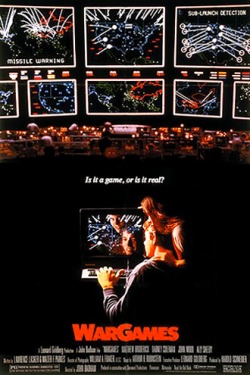
Hello, cyber fans! Welcome back to the second episode of Popcorn and Cyber, where we watch and discuss movies that feature hacking and cybersecurity. Today, we are traveling back in time to the dawn of the digital age to look at a 1983 classic that practically invented the Hollywood hacking genre: WarGames.
WarGames is a sci-fi techno-thriller directed by John Badham, starring a very young Matthew Broderick as David Lightman. David is a bright but unmotivated high school student and basement hacker who accidentally dials into a military supercomputer named WOPR (War Operation Plan Response) while looking for a gaming company’s unreleased video games. Believing he is playing a harmless game of “Global Thermonuclear War,” David unknowingly sets the U.S. military on a path to World War III.

The movie is highly celebrated for its suspense, its brilliant take on Cold War anxieties, and its cultural impact. In fact, it was so influential that it famously prompted President Ronald Reagan to ask his joint chiefs if a scenario like this could actually happen, leading directly to the creation of the first official U.S. federal cybersecurity policy!
But how realistic is WarGames when it comes to the actual hacking and cybersecurity? Pull up a chair and let’s find out.
First of all, let’s talk about the premise of how David gets into the system. David uses a technique known as “wardialing”—which, fun fact, was actually named after this movie! He programs his computer to automatically dial every telephone number in a specific area code until it finds a modem tone. This part is actually incredibly realistic for the 1980s. Before the modern internet took off, hacking was deeply tied to the telephone network.

However, where things get a bit implausible is the defense posture of NORAD (North American Aerospace Defense Command). WOPR is a highly classified military supercomputer tasked with commanding the nation’s nuclear arsenal. Why on earth is it connected to a standard, outside commercial telephone line that anyone with a modem can dial into? In reality, a military system of that scale would be on an entirely closed, secure network. But hey, if WOPR had proper network segmentation, we wouldn’t have a movie!
Secondly, let’s look at the hacking techniques David uses to log into WOPR. After finding the system, he is prompted for a password. Instead of using a sophisticated exploit, he does some classic open-source intelligence (OSINT) and social engineering. He researches the system’s creator, Dr. Stephen Falken, and discovers he was obsessed with his deceased son, Joshua. David guesses that the backdoor password is “Joshua”—and boom, he’s in.
While guessing passwords based on personal information is still a massive cybersecurity issue today (please don’t name your password after your dog!), the way the movie depicts it is a bit dramatized. WOPR is an advanced AI, yet it doesn’t have a basic account lockout policy? After a few incorrect password attempts, David should have been locked out, and a military security team should have been tracking his phone line. Instead, WOPR just lets him guess indefinitely. Talk about a lack of brute-force protection!

Thirdly, let’s talk about the cybersecurity and AI measures taken by NORAD. WOPR is designed to remove human error from nuclear launch decisions by automating the entire process using machine learning and predictive simulations. The climax of the movie features WOPR frantically trying to crack the nuclear launch codes itself via a brute-force attack while the humans watch helplessly because they can’t override the system.
To stop WOPR from launching real missiles, David forces the computer to play Tic-Tac-Toe against itself. Because Tic-Tac-Toe always results in a draw if both players play perfectly, WOPR runs millions of simulations, learns the concept of a “futile game,” and applies that logic to nuclear war, concluding that “the only winning move is not to play.”
As beautiful and poetic as that ending is, it’s not exactly how AI or cybersecurity incident response works. If a military computer became compromised or went rogue, the solution wouldn’t be to challenge it to a game of Tic-Tac-Toe; it would involve physically cutting the power, pulling the network cables, or using a hardcoded, un-hackable manual override. Furthermore, machine learning models don’t just suddenly experience a philosophical epiphany in the middle of a brute-force sequence.
Of course, we have to look past these technical shortcuts and remember the era the movie was made in. WarGames wasn’t trying to be a technical manual for network engineering; it was a cautionary tale about over-relying on automation, the dangers of AI before we truly understood it, and the absurdity of the Cold War doctrine of Mutually Assured Destruction.

Despite the cinematic liberties, WarGames holds up remarkably well. It gave us iconic imagery, popularized the terms “wardialing” and “backdoor,” and inspired an entire generation of real-world cybersecurity professionals to start tinkering with technology.
It is an absolute must-watch for any cyber fan, offering a nostalgic look at floppy disks, acoustic couplers, and CRT monitors, wrapped in a genuinely tense plot.

So grab your popcorn, secure your modems, and join us next time for another episode of Popcorn and Cyber. Until then, remember: keep your passwords strong, and maybe stick to playing Chess.
Leave a Reply