
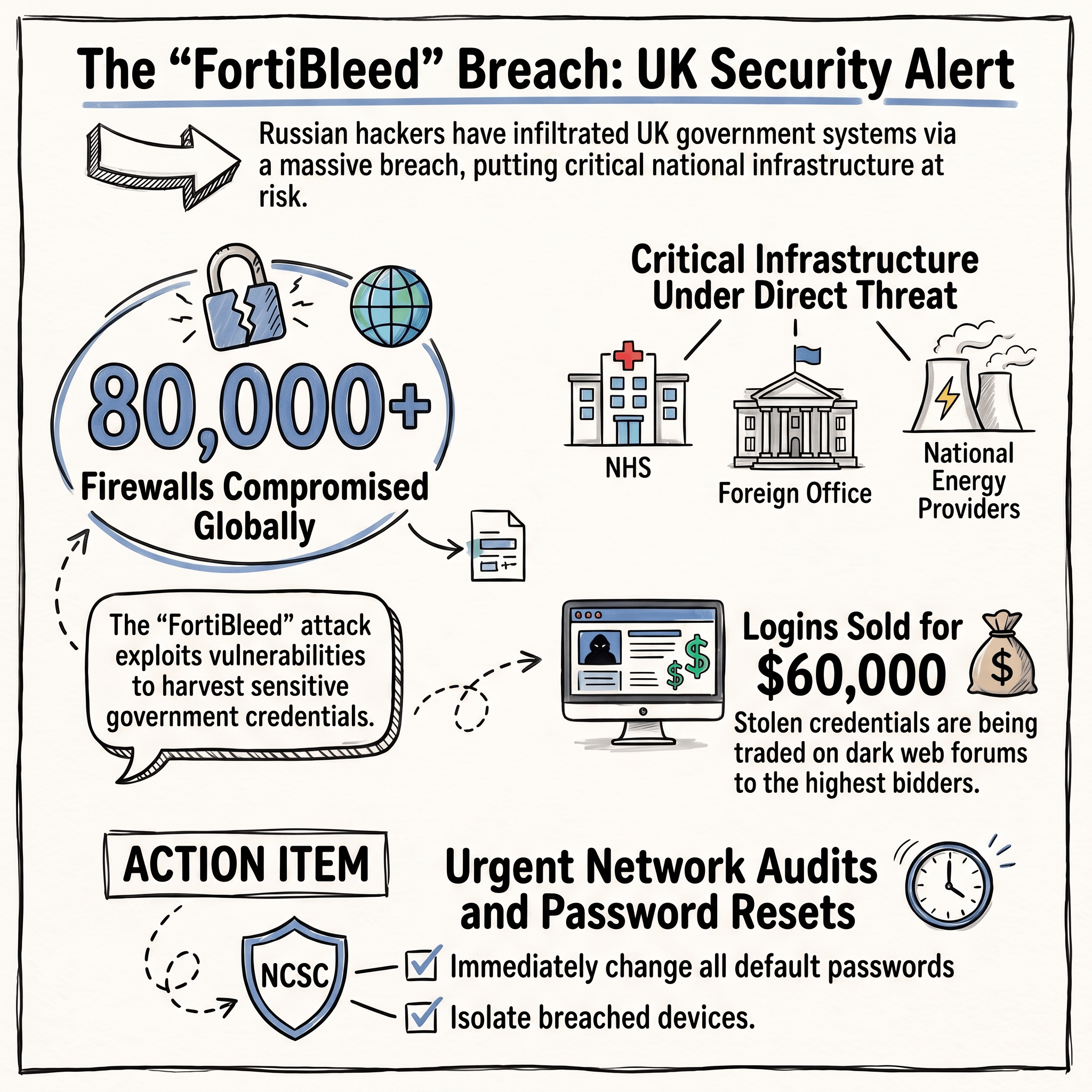
A single set of login credentials is no longer just a personal secret; in the current geopolitical climate, it is the master key to a nation’s foundational infrastructure. The “FortiBleed” crisis has exposed a chilling reality: security perimeters once thought to be ironclad have been systematically bypassed. By exploiting a specific vulnerability in Fortinet systems, attackers have compromised over 80,000 firewalls, turning the very tools meant to protect us into gateways for foreign infiltration. This is not a drill or a localised IT glitch—it is a sophisticated, ongoing assault on the heart of Whitehall and the critical systems that keep the United Kingdom functioning.
1. Your Digital Identity is a High-Value Commodity
We are witnessing the industrialization of access. In the dark corners of the web, stolen data has evolved from mere information into a premium financial asset. The FortiBleed breach specifically harvested high-value entry points, including the UK Foreign Office and various local government entities. These aren’t just random logins; they are the “keys to the kingdom,” comprising verified emails and coinciding passwords that provide a direct line into the British state.
The market has responded accordingly. An operator known as “SantaAd” is currently trading access to these government credentials for as much as $60,000 (£44,000). This valuation proves that for modern adversaries, “access” is now the primary product, sold to the highest bidder to facilitate deep, long-term infiltration.
Researcher Volodymyr Diachenko, who first identified the breach, noted that the infiltration provided access to “core networks” within the Foreign Office. His findings revealed that IT staff at British embassies in Thailand and Mauritius, as well as local government officials in Derbyshire and Waltham Forest in east London, have seen their credentials weaponized on the open market.
2. The Healthcare Vulnerability is Physical, Not Just Digital
The “FortiBleed” breach serves as a stark reminder that cyberattacks have moved beyond the screen to threaten human life. When software like Fortinet is compromised, the impact ripples through the NHS, pharmacies, laboratories, and—crucially—energy providers and medicine suppliers. These entities represent the physical backbone of the country; when their IT systems fail, hospital wards go dark and life-saving supplies stop moving.
This is not a theoretical fear. We saw the blueprint for this chaos in the 2024 attack on Synnovis, which forced the cancellation of over 1,000 operations and 2,000 appointments. FortiBleed targets these same dependencies, but on a much wider scale.
Dr. Saif Abed, a cybersecurity expert and former doctor, issued a blunt warning: “This is exactly the type of hack that’s the first step for launching catastrophic ransomware attacks that can threaten patient safety across the country.”
3. The Rise of the “Nurtured” Proxy Hacker
The “smoking gun” of this investigation lies in the mechanics of the attack itself: the underlying code for the FortiBleed hack is written in Russian. While the Kremlin maintains a layer of “plausible deniability,” the relationship between the Russian state and these hackers has evolved into a strategic sanctuary model. This is a deliberate “quid pro quo” where hackers are permitted to operate with impunity from within Russian borders as long as they direct their disruption toward Western targets and stay within Moscow’s “red lines.”
Anne Keast-Butler, the head of GCHQ, has signaled a fundamental shift in this threat landscape. The state is no longer merely turning a blind eye; it is actively “nurturing and inspiring” these non-state actors. By providing a safe haven, Russia has turned cybercrime into a low-risk, high-reward tool of statecraft that makes international legal enforcement almost impossible.
4. The “Brute Force” of Recycled Data
There is a profound technical irony at the heart of FortiBleed. While the breach targets high-end national security infrastructure, it is being fueled by “lazy” security habits. According to the National Cyber Security Centre (NCSC), attackers are using a “brute force” methodology—leveraging valid credentials harvested from previous, unrelated leaks to unlock new doors.
The most dangerous aspect of this strategy is the “collection hub” concept. Once a Fortinet device is breached using recycled data, it is essentially repurposed by the enemy. The compromised hardware becomes an internal spy, used to harvest further data and credentials from within the network. This creates a self-sustaining cycle where one weak password can eventually compromise an entire government department.
5. Immediate Defense in an Active War Zone
The NCSC has classified this as an active and ongoing threat. This is not a historical event to be studied; it is a live crisis requiring immediate tactical intervention. For organizations utilizing Fortinet edge devices, the NCSC has outlined critical steps to sever the attackers’ foothold:
- Network Auditing: Review all logs immediately to identify unauthorized access or the “internal spy” traffic patterns typical of a collection hub.
- Device Isolation: Any device suspected of compromise must be disconnected and isolated to prevent hackers from moving laterally into more sensitive core networks.
- Credential Overhaul: Change all default or reused passwords immediately, with a specific focus on VPNs and firewalls.
- Active Monitoring: Enroll in the NCSC Early Warning service to receive real-time intelligence on malicious activity targeting your specific infrastructure.
The Shifting Frontline
The FortiBleed crisis confirms that cybersecurity is no longer a secondary IT concern; it is the primary pillar of national resilience. When the digital perimeters of the Foreign Office and the NHS are breached, the frontline of national defense moves from the English Channel to the server room.
Ultimately, this crisis forces us to confront a systemic vulnerability: our reliance on a concentrated pool of security providers. When one vulnerability can compromise 80,000 firewalls simultaneously, we have created a single point of failure for the entire state. If we do not diversify our defenses and tighten our digital hygiene, the next “Bleed” could be terminal.
Leave a Reply