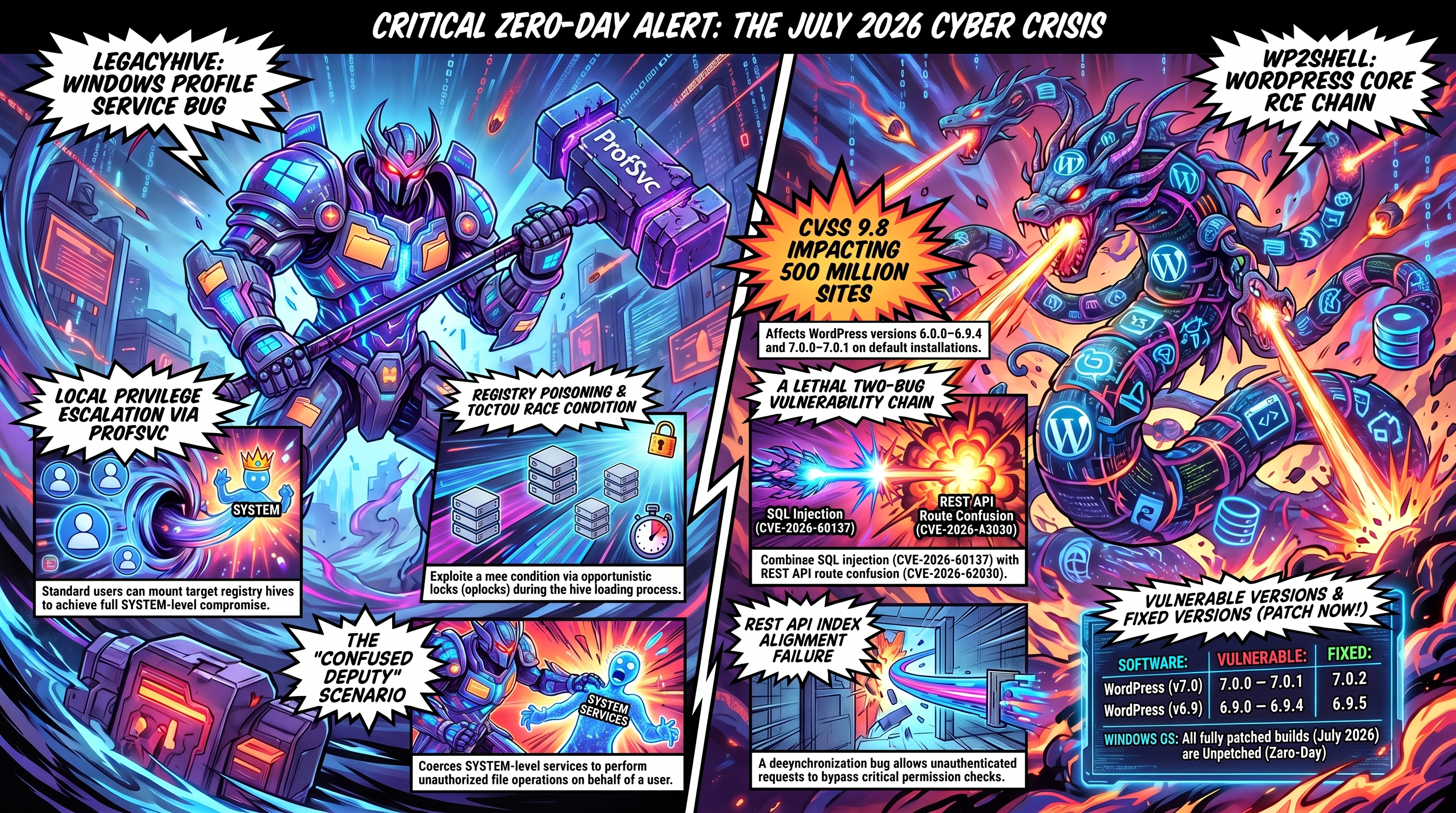
For system administrators, July 14, 2026, was supposed to be the day the bleeding stopped. Microsoft had just unloaded its most massive Patch Tuesday in history, a 600-CVE behemoth designed to fortify the Windows ecosystem against a rising tide of sophisticated threats. Yet within 48 hours, that “fully patched” shield was revealed to be a hollow shell. Two catastrophic vulnerabilities—LegacyHive and wp2shell—shattered the industry’s sense of security, proving that even the most aggressive patching cycles are no match for logic flaws and a researcher with a grudge.
If the most comprehensive update in the history of software can’t save us, what can? To answer that, we have to look at the anatomy of the collapse: a Windows service that forgot how to verify its own paths and a two-line error in WordPress that left half a billion sites vulnerable to anonymous takeover.
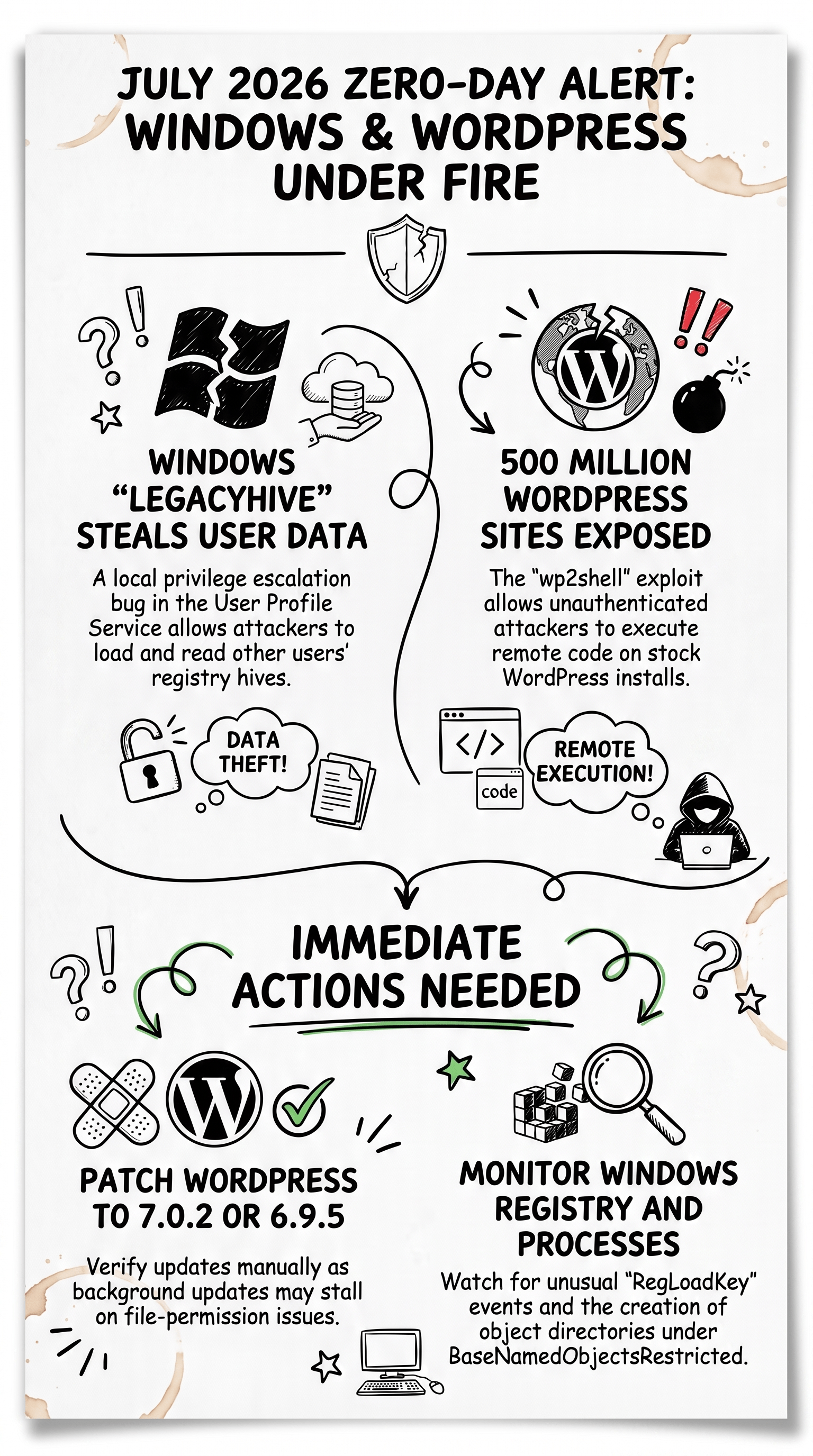
LegacyHive: When Windows Forgets Whose Registry It’s Loading
The first blow was a direct act of defiance. The researcher known as “Nightmare-Eclipse” (or “Chaotic Eclipse”), who has spent months taunting Microsoft as a self-styled “nemesis” after the tech giant allegedly threatened them with legal action, released an exploit targeting the Windows User Profile Service (ProfSvc). Dubbed LegacyHive, it is a classic “Confused Deputy” scenario where a SYSTEM-level service is coerced into performing unauthorized actions for a low-privileged user.
The exploit is a masterclass in desynchronization. It requires three arguments—a helper account, its password, and a target user—to stage a localized heist. The attacker first generates a random GUID folder under C:\ as a “shadow directory,” granting GENERIC_ALL permissions to everyone. By resolving NtCreateSymbolicLinkObject, the exploit creates an Object Manager path: \\.\GlobalRoot\BaseNamedObjects\Restricted.
The “trick” involves poisoning the “Local AppData” registry value to point toward this namespace. When the User Profile Service attempts to construct a path to %LOCALAPPDATA%\Microsoft\Windows\UsrClass.dat, the poisoning redirects it to the attacker’s shadow directory. By using a “Time-of-Check to Time-of-Use” (TOCTOU) race condition facilitated by opportunistic locks (oplocks), the attacker stalls the service. At the exact moment ProfSvc pauses, the symbolic link is swapped, forcing the SYSTEM-level service to load the target user’s (e.g., an Administrator’s) UsrClass.dat hive into the attacker’s session.
While critics at outlets like TechRadar have noted that the current PoC only mounts the hive with read access—revealing Explorer history and forensic artifacts rather than password hashes—the systemic risk is undeniable. The researcher has already warned that simple modifications could allow any hive to be mounted.
“LegacyHive is an unpatched local privilege escalation vulnerability… [that] allows a low-privileged user to gain unauthorized access to sensitive registry data or potentially achieve full SYSTEM compromise.”
wp2shell: The Two-Line Bug That Bypassed Half a Billion Permission Checks
While Windows admins were monitoring their registries, the WordPress ecosystem—which powers 43% of the web—collapsed into an “apocalypse” of its own making. The vulnerability, “wp2shell,” is a pre-auth Remote Code Execution (RCE) flaw residing in the default REST API batch endpoint.
The absurdity of wp2shell lies in its simplicity: a two-line index desynchronization error in the WP_REST_Server::serve_batch_request_v1() function. When a user sends a batch of sub-requests, WordPress maintains parallel arrays: $requests, $validation, and $matches. If a sub-request fails an early-stage validation (like a malformed URL), the error is recorded in $validation but the entry is skipped in $matches.
This causes the $matches array to become shorter than the $requests array. The dispatch loop then indexes incorrectly into the shortened array, evaluating a malicious sub-request against the wrong handler’s permission callback. An anonymous user can steer execution into a privileged sink simply by ordering their requests carefully. Crucially, this works even if “pretty permalinks” are disabled, as it responds to the query string /?rest_route=/batch/v1.
“When anonymous code execution ships in software that runs half a billion sites, the question is not whether you have it. The question is which of your instances an attacker can actually reach.”
The Lethal Art of Vulnerability Chaining
The events of July 2026 prove that security teams can no longer afford to view “low risk” bugs in isolation. Both LegacyHive and wp2shell achieved their catastrophic impact through the lethal art of vulnerability chaining.
In the case of WordPress, the RCE path is forged by linking a SQL injection in the author__not_in parameter of WP_Query (CVE-2026-60137, affecting versions 6.8+) with the REST API route confusion (CVE-2026-63030, affecting 6.9+). Separately, these bugs might be managed; together, they grant an anonymous user the keys to the kingdom.
For Windows, LegacyHive chains registry poisoning with symbolic link manipulation and the tactical use of oplocks. It is a reminder that a bug’s severity is defined by its neighbor. If a minor logic flaw in a high-privilege service can be reached via a user-controlled registry value, the entire security boundary is compromised.
The End of ‘Optional’ Security
The response to these threats has signaled a fundamental shift in software maintenance. Recognizing the scale of wp2shell, the WordPress team took the unprecedented step of forcing automatic updates across its entire global ecosystem to push the two-line fix. However, analysts warn that version-string stripping—a common hardening technique—fails to stop these exploits. Detection must move to the traffic level, specifically monitoring for the deterministic desync signatures found in the REST batch routes.
For LegacyHive, the path forward is more complex. Until a formal patch arrives, defenders must move beyond “Patch Tuesday” reliance and implement aggressive monitoring. This includes:
- Path Canonicalization: Ensuring resolved paths stay within legitimate profile directories and rejecting
\\.\GlobalRootor object-manager prefixes. - Contextual I/O: Forcing I/O operations to occur within the user’s security context rather than the SYSTEM context.
- Active Monitoring: Watching for the specific string “oplock triggered!” or the suspicious resolution of
NtCreateSymbolicLinkObjectandCreateProcessWithLogonWby non-standard processes.
Conclusion: The Future of the Eternal Arms Race
The security landscape of July 2026 feels less like a series of isolated incidents and more like a systemic breakdown. When a researcher like “Chaotic Eclipse” releases zero-days to spite tech giants, and a two-line indexing error can topple 500 million websites, our current patching model is revealed as fundamentally broken.
The “bone-shattering” exploits promised by the Microsoft Nemesis may have been hyperbolic in their initial state, but they have successfully exposed the fragility of the “fully patched” myth. In this new era, the update is only the beginning. True defense lies in understanding the traffic, the logic, and the chains that the patches missed.
When the next Patch Tuesday lands, will you be watching the updates, or the traffic they missed?
Leave a Reply