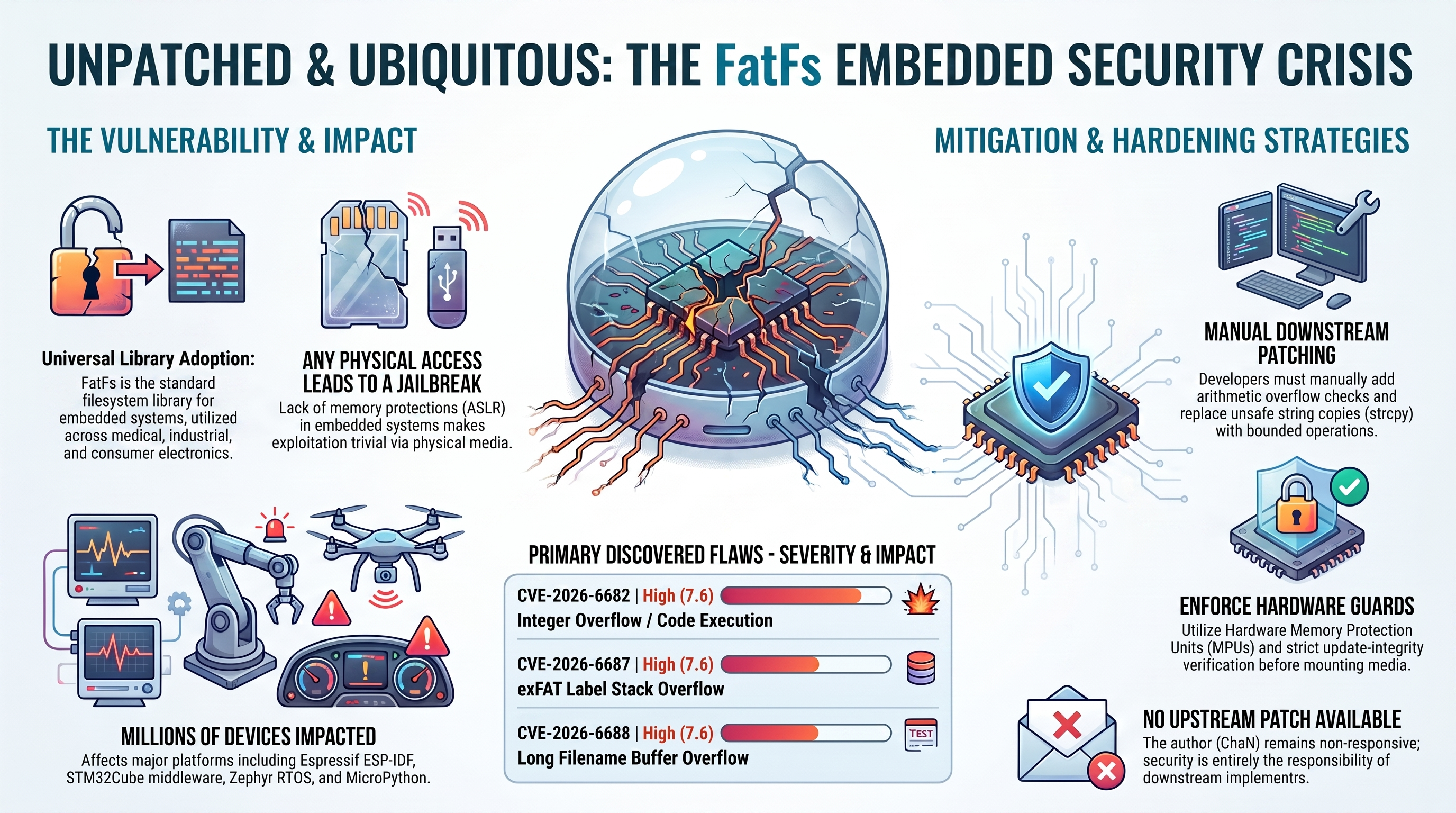
We’ve all seen XKCD 2347: a rickety tower representing global infrastructure, balanced precariously on a single, thankless project maintained by a random person in Nebraska. In the real world of embedded systems, that project is often FatFs—a tiny, ubiquitous filesystem library that has quietly become a massive blind spot in the supply chain.
Security researchers at runZero recently pulled back the curtain on this hidden dependency, revealing seven unpatched vulnerabilities in FatFs that create a staggering “blast radius.” From consumer drones and security cameras to medical hardware and industrial controllers, the code that manages how these devices read and write to SD cards and USB drives is fundamentally broken.
The XKCD Dependency Reality: A Massive Blast Radius
FatFs is the epitome of the “silent” supply chain risk. It is compact, highly functional, and because it is designed for resource-constrained environments, it has been copied into almost every corner of the modern tech stack. It isn’t just a hobbyist tool; it is the foundation for major non-hobby platforms.
The vulnerabilities affect a wide array of high-profile downstream platforms, including:
- Espressif ESP-IDF
- STMicroelectronics STM32Cube middleware
- Zephyr RTOS
- RT-Thread
- SWUpdate
- MicroPython
- ArduPilot
- Arm Limited Mbed
- Samsung TizenRT
- RIOT OS
Remediation is a nightmare because of “vendoring”—the practice of copying the library’s source code directly into a firmware project and modifying it locally. There is no central “Update” button to click. Every vendor must manually audit and patch their own fork of the code.
“One component, maintained in one tiny corner of the internet, quietly supports an absurd amount of modern cyber-stuff.”
The AI Vibe Shift: When Fuzzing Becomes “Trivial”
The 2026 revisited audit of FatFs marks the end of the “manual-only” era of vulnerability research. This was essentially a cold case; a manual audit and multi-day fuzzing effort in 2017 found only basic, non-compelling bugs.
Nine years later, the landscape has shifted. Using GitHub Copilot in “auto” mode with simple, non-expert prompts, researchers built fuzzers that identified critical flaws that human auditors missed for nearly a decade. They validated exploits without requiring specific loops, harnesses, or specialized skills. We have officially entered the age of the “apex agentic adversary.” If researchers can weaponize metadata in seconds using AI, we must assume attackers are already doing the same.
The “Physical Jailbreak”: Why Removable Media is Now a Weapon
The threat model here is centered on the “physical jailbreak.” Consider any device where the public has brief physical access: security cameras with SD slots, ATMs, voting machines, or hardware crypto wallets.
Embedded systems are uniquely vulnerable to this. Unlike PCs, these devices almost universally lack modern mitigations like Address Space Layout Randomization (ASLR) and hardware-level memory protection. In this environment, a single memory corruption bug isn’t just a crash; it’s a total system compromise.
“Any physical access leads to a jailbreak, especially given the lack of address space layout randomization (ASLR) and memory protection.”
CVE-2026-6682: The Integer Overflow Headline
The most severe finding is CVE-2026-6682, a classic “multiply-and-wrap” arithmetic error in the mount_volume() function. During FAT32 mount processing, the calculation fasize *= fs->n_fats can wrap around.
The technical nuance is critical: this truncated result shifts the fs->database pointer into attacker-controlled FAT space. This allows an attacker to forge trusted metadata, such as finfo.fsize. When downstream applications trust this forged file size as a read length—a common pattern in embedded development—a subsequent f_read() can be forced to overflow stack or heap buffers. This turns a simple mount operation into a memory-corruption primitive, facilitating remote code execution.
The Upstream Silence: A Supply Chain Without a Safety Net
The investigative timeline reveals a disturbing lack of coordination in the hardware supply chain. Coordination attempts began in March 2026, with runZero and JPCERT/CC making multiple efforts to reach the author, ChaN. JPCERT/CC alone made three separate attempts in Japanese to secure a response, but the upstream source remains silent.
As of the July 1, 2026 disclosure date, version R0.16 remains the latest release—and it is fully vulnerable. With no official patch, the burden of security falls entirely on the developers.
Critical Manual Remediation Steps:
- Arithmetic Overflow Checks: Manually add checks to the partition mounting logic to prevent the “multiply-and-wrap” condition.
- Bounded String Operations: Replace unsafe operations like
strcpyandsprintfwith bounded versions (strncpy,snprintf), particularly when handling Long Filenames (LFN) and reading volume labels in functions likef_getlabel(). - Strict Update Integrity: Enforce full signature verification of OTA (Over-the-Air) containers before they are ever mounted by the filesystem.
Conclusion: Defending in the Age of Automated Audits
The FatFs crisis proves that “security through obscurity” or keeping vulnerabilities quiet is pure security theater. When AI can audit and dismantle code in seconds, the traditional, slow disclosure cycle is obsolete.
As we look at the “unmanageable” devices surrounding us—from the cameras in our hallways to the industrial controllers in our power grids—we have to face a provocative reality. In an age where AI can audit code in seconds, how many more “unmanageable” dependencies are still ticking in the devices we trust with our lives and data?
Leave a Reply