
In the modern enterprise, the SonicWall SMA 1000 series acts as the definitive “front door.” Designed to aggregate remote access credentials and provide a secure gateway for a hybrid workforce, these appliances sit at the very edge of the network. By necessity, they are internet-facing, serving as the primary barrier between the public wilderness and an organisation’s most sensitive internal assets.
Imagine a high-security vault equipped with biometric scanners and reinforced steel. For years, organisations have trusted this gate to keep intruders out. However, on July 14, 2026, the industry learned that the locks were not just pickable—they could be bypassed entirely. When an edge appliance, the very tool meant to provide security, is compromised, it offers attackers a direct line to administrator credentials, active session tokens, and a comprehensive roadmap of the internal architecture.
The disclosure of two zero-day vulnerabilities in the SMA 1000 series has fundamentally shifted the risk landscape. These are not merely bugs to be squashed; they represent a lethal breach of the secure perimeter that many organisations rely on for survival.
The Keys to the Castle: Anatomy of a Lethal Chain
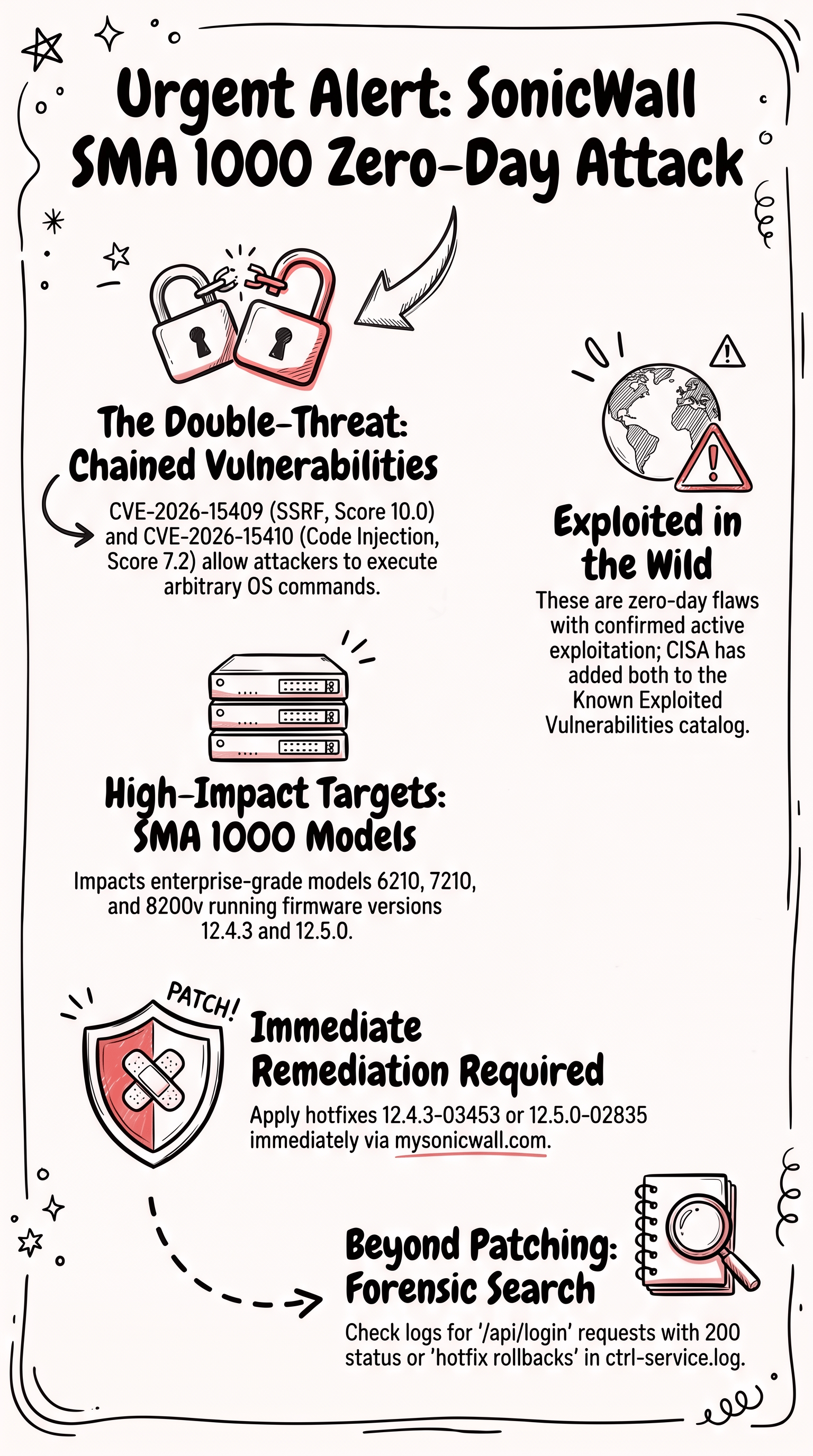
The primary danger of this disclosure lies in the sophisticated relationship between two distinct flaws: CVE-2026-15409 and CVE-2026-15410. To understand the gravity of the situation, one must look at how these vulnerabilities interact.
Think of it as a “Keys to the Castle” scenario. CVE-2026-15410 is a code injection vulnerability located within the Appliance Management Console (AMC). It is effectively a vault that requires a specific key—administrator-level authentication—to open. Under normal circumstances, this would be a high-bar target. However, CVE-2026-15409, a critical Server-Side Request Forgery (SSRF) flaw, acts as a “back-office bypass.” By exploiting the SSRF via the public-facing “Work Place” interface, an unauthenticated attacker can relay requests to the restricted AMC interface, effectively walking around the locked front door and standing inside the vault with the same privileges as a system admin.
As noted by security researchers at Tenable:
“While the advisory does not specify if they were exploited in tandem, together they form a fully remote, unauthenticated path to arbitrary OS command execution on affected appliances.”
This investigation was significantly advanced by the contributions of Sean Koessel and Steven Adair of Volexity, who helped identify critical indicators that revealed the depth of this “chained” exploitation.
The Anatomy of a 10.0: Why SSRF is the Ultimate Pivot
The SSRF vulnerability, CVE-2026-15409, carries a CVSS score of 10.0—the highest possible severity rating. In the context of an internet-facing gateway, an SSRF of this magnitude is the ultimate pivot point. It allows a remote, unauthenticated actor to force the appliance to communicate with internal services that were never intended to be exposed to the web.
Beyond merely reaching the management console, this allows attackers to probe hidden internal network segments or relay authentication material. It effectively turns the organisation’s own security infrastructure against it, transforming a defensive gateway into a reconnaissance tool for lateral movement.
The Credential Goldmine: A History of Targeted Exploitation
The targeting of SonicWall’s SMA product line is not a matter of bad luck; it is a calculated choice by threat actors. Because these devices are identity gatekeepers that aggregate sensitive credentials, they represent a “goldmine” worth the high R&D cost of zero-day development. We have seen a relentless pattern of exploitation over the last several years:
- 2019: Critical SQL injection and directory traversal flaws (CVE-2019-7481, CVE-2019-7483).
- 2021: A zero-day SQL injection (CVE-2021-20016) was actively targeted in the wild.
- 2024: Improper access control in SonicOS (CVE-2024-40766) led to a massive surge in ransomware activity, notably by groups like Akira.
- 2025: High-stakes vulnerabilities continued with zero-day deserialization (CVE-2025-23006) and privilege escalation (CVE-2025-40602).
This history illustrates that for state-sponsored actors and ransomware cartels, the SMA series remains a Tier-1 objective for establishing long-term persistence within the enterprise.
Beyond the Patch: The Shocking Truth of Persistence
For most vulnerabilities, a firmware update signals the end of the crisis. Here, it is merely the beginning of the recovery phase. Because these flaws were exploited as zero-days before a patch existed, there is a high probability that attackers have already established a foothold. If an adversary has already moved laterally or installed a backdoor, the patch will secure the door, but it won’t remove the intruder already inside.
As a SonicWall spokesperson emphasised:
“It is important that customers understand patching alone is not sufficient. Even after applying the update, we strongly recommend reviewing logs for indicators of compromise.”
Administrators must pivot from simple remediation to active forensic investigation to ensure their environment hasn’t been compromised prior to the update.
The 72-Hour Red Alert: Urgent Federal Intervention
The speed of the official response highlights the extreme risk to global infrastructure. Both CVEs were added to CISA’s Known Exploited Vulnerabilities (KEV) catalogue on July 14, 2026. Crucially, CISA set a remediation deadline of July 17, 2026. This 72-hour window is exceptionally rare and serves as a “Red Alert.” Such an abbreviated timeline reflects a high degree of confidence that active exploitation is widespread and that the window for securing these devices is closing rapidly.
The Investigative Toolkit: Hunting for Smoking Guns
Organizations utilizing SMA 1000 models 6210, 7210, or 8200v must immediately review their logs. Certain anomalies should be treated not just as suspicious, but as “smoking guns” of a breach:
- Extraweb Access Logs: Any requests to
/api/loginor/api/logoutwith an HTTP 200 status code are definitive indicators of compromise, as these URIs do not exist in legitimate configurations. - Proxy Anomalies: Monitor
extraweb_access.logfor requests to/wsproxycontaining suspicious host parameters and a 101 HTTP status. - Service Logs: Inspect
ctrl-service.logfor hotfix rollbacks that utilise path traversal naming conventions. - Configuration Files: Check
/var/lib/unit/conf.jsonfor unauthorised routes related to the aforementioned non-existent API endpoints.
Rethinking the Architecture of Access
The discovery of the CVE-2026-15409 and CVE-2026-15410 chain demands a rigorous recovery path. If any indicators of compromise are found, the appliance cannot be trusted. Physical hardware must be re-imaged, virtual appliances must be completely re-deployed, and every user and administrator password—along with TOTP tokens—must be reset.
This incident serves as a stark reminder that edge-of-network appliances are high-stakes targets. When the very devices we use to secure our perimeter become the primary vector for its collapse, it forces a philosophical shift. As the “front doors” to our digital estates become the primary battleground, is it time to rethink the architecture of remote access entirely, moving toward a model where the perimeter is no longer a single, breakable point of failure?
Leave a Reply